
Tethered vs Untethered EV Charger: Which Should You Buy?
The Short Answer
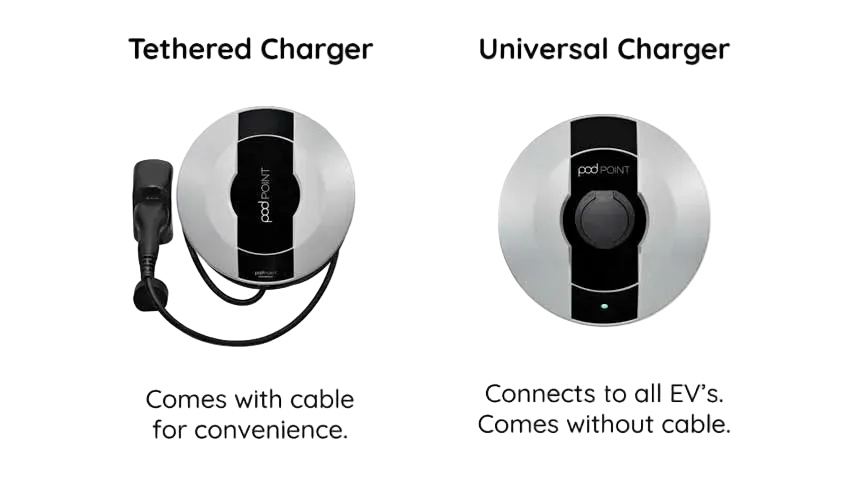
A tethered charger has a fixed cable attached to the wall unit. An untethered charger has a socket on the unit and you bring your own cable. For most UK homes with one EV, tethered wins on convenience every time. Untethered suits specific situations: multiple EVs, shared driveways, or drivers who already own a good cable and want to keep things flexible.
The rest of this guide covers the specifics so you can make the call with confidence.
What Tethered Means in Practice
With a tethered charger, the Type 2 cable lives on the wall unit permanently. You walk to the car, pull the cable, plug in. When the session ends, the cable goes back on its hook or wraps around the unit. That is the entire process, repeated every night.
The cable is always where you left it. No searching the boot, no unrolling a damp cable from the garage floor, no forgetting it at home before a long drive. For households charging one EV overnight, this simplicity is the main practical advantage.
The trade-off: the cable is fixed to the unit. If you switch to a different EV with a different connector type years down the line, you may need a new charger rather than a new cable.
What Untethered Means in Practice
An untethered charger has a Type 2 socket on the front. You need a separate cable, plugged in at both ends every session: one end into the charger, one end into the car.
This suits households with two EVs using different connector types. One charger serves both vehicles as long as you have the right cables for each. It also suits drivers who travel with a portable cable and want the same cable to work at home and at public charge points. The hardware stays minimal on the wall when no car is connected.
The practical downside: the cable needs to live somewhere accessible. Left in the boot, you remember it when the session is ready to start. Left in the garage, it can end up dirty, tangled, or in the way.
Comparison at a Glance
| Tethered | Untethered | |
|---|---|---|
| Cable always ready | Yes | No, you bring it |
| Works with multiple EVs | One connector type only | Yes, with right cables |
| Looks tidy when not charging | Cable on unit | Clean socket face |
| Cable theft risk | None | Cable can be taken |
| Future connector flexibility | Limited | Change cable, keep charger |
| Typical home user | Single EV household | Multi-EV or flexible setup |
Tethered Charger Recommendations
These are the tethered chargers ON-EV installs most frequently. Each suits a different buyer.
Hypervolt Home 3 Pro | 7.4kW | IP66 | Solar + Octopus Ready
Myenergi Zappi V2 | 7.4kW | UK's #1 Solar EV Charger
Ohme Home Pro | 7.4kW | LCD Screen | 4G Built-in
Andersen A3 | 7.4kW | Hidden Cable | 247 Colour Options
Untethered Charger Recommendations
These units use a socket rather than a fixed cable, giving you flexibility over which cable you use.
Ohme ePod | 7.4kW | Compact | 4G Built-in | OZEV Approved
EO Mini Pro 3 | 7.2kW | IP65 | Solar CT Clamps Included
The One That Does Both
The Easee One is the only home charger on the UK market that works tethered and untethered from the same unit. Attach a cable and it operates as tethered. Leave the cable off and you use the socket with your own cable. No hardware change needed, no buying a different unit if your situation changes.
It also runs three charging points from a single fuse, which makes it a practical choice for two-car households or small shared driveways.
Easee One | 7.4kW | Works Both Ways | OZEV Approved
Cable Standards: Should You Worry About Future Changes?
All EVs sold in the UK use the Type 2 AC connector for home charging. This standard is set at the EU level and is not going to change in any meaningful timeframe. North America uses NACS, which is why you see confusion in US-based comparisons, but that does not apply to UK-spec chargers.
The practical answer: do not base your tethered or untethered decision on fears about connector standards changing. Buy what suits your current situation. If you have one Type 2 car, tethered is the better daily experience. If you have two different cars today, go untethered or buy the Easee One.
Shared Driveways and Rental Properties
Untethered chargers are the better fit for shared driveways where multiple households use the same charge point. Each household brings their own cable, so there is no dispute over a shared tethered cable and no risk of someone using or damaging it.
For rental properties, untethered also reduces the landlord's liability since the cable sits with the tenant rather than fixed to the property. The OZEV grant for rental properties and flats applies to both tethered and untethered units as long as the charger is on the approved list.
Get a Recommendation from ON-EV
ON-EV installs both tethered and untethered chargers across North Wales and the North West. If you want a recommendation based on your property, your car, and your situation, get in touch. We will point you to the right unit and handle the full installation.
Frequently Asked Questions
Can I change a tethered charger to untethered later?
No. The cable on a tethered unit is fixed. To switch, you would need a new charger. The Easee One is the exception as it supports both from the same hardware.
Does untethered cost less to install?
The installation cost is the same. The charger unit itself may cost slightly less without a cable, but you then need to buy a Type 2 cable separately.
Is a tethered cable safe to leave outside?
Yes. Tethered cables on OZEV-approved chargers are rated for outdoor use. Leave it on the holster or cable wrap when not in use.
What Type 2 cable do I need for an untethered charger?
A 32A Type 2 to Type 2 cable for most current EVs. Check your car's charging port before buying. ON-EV stocks Type 2 cables if you need one alongside your charger.
Does the OZEV grant apply to both types?
Yes, where the charger model holds OZEV approval. The tethered or untethered distinction does not affect grant eligibility.