
Hydra Cubus EV Charger Review UK (2026)
Quick Verdict
The Hydra Cubus makes most sense to buyers who know what a Type B RCD costs to source separately (around £80 to £150) and why O-PEN protection matters on PME supplies. Both are built in. At £354, with OZEV approval, solar modes, and a 3-year warranty, the spec sits well above the price tag.
Hydra Cubus EV Charger | 7.4kW | Type B RCD | OZEV Approved
Specifications
| Specification | Detail |
|---|---|
| Power Output | 7.4kW (32A single phase) |
| Adjustable Current | 6A to 32A |
| Connector | Type 2 tethered or socketed |
| Enclosure Rating | IP54 (socketed) / IP65 (tethered) |
| Impact Rating | IK10 |
| Dimensions | 260 x 260 x 100mm |
| Weight | 3.5kg (socketed) / 5.5kg (tethered) |
| Operating Temperature | -25°C to 50°C |
| Connectivity | Wi-Fi, Bluetooth, Ethernet, 4G |
| App | Hydra Nexus Pro |
| RFID | Yes, built in |
| Solar Compatible | Yes (ECO and ECO+ modes) |
| Built-in Type B RCD | Yes (DC 6mA + AC 30mA) |
| O-PEN Protection | Yes |
| OCPP | 1.6 |
| OZEV Approved | Yes |
| Warranty | 3 years |
| Price | £354 |
Build Quality and Design
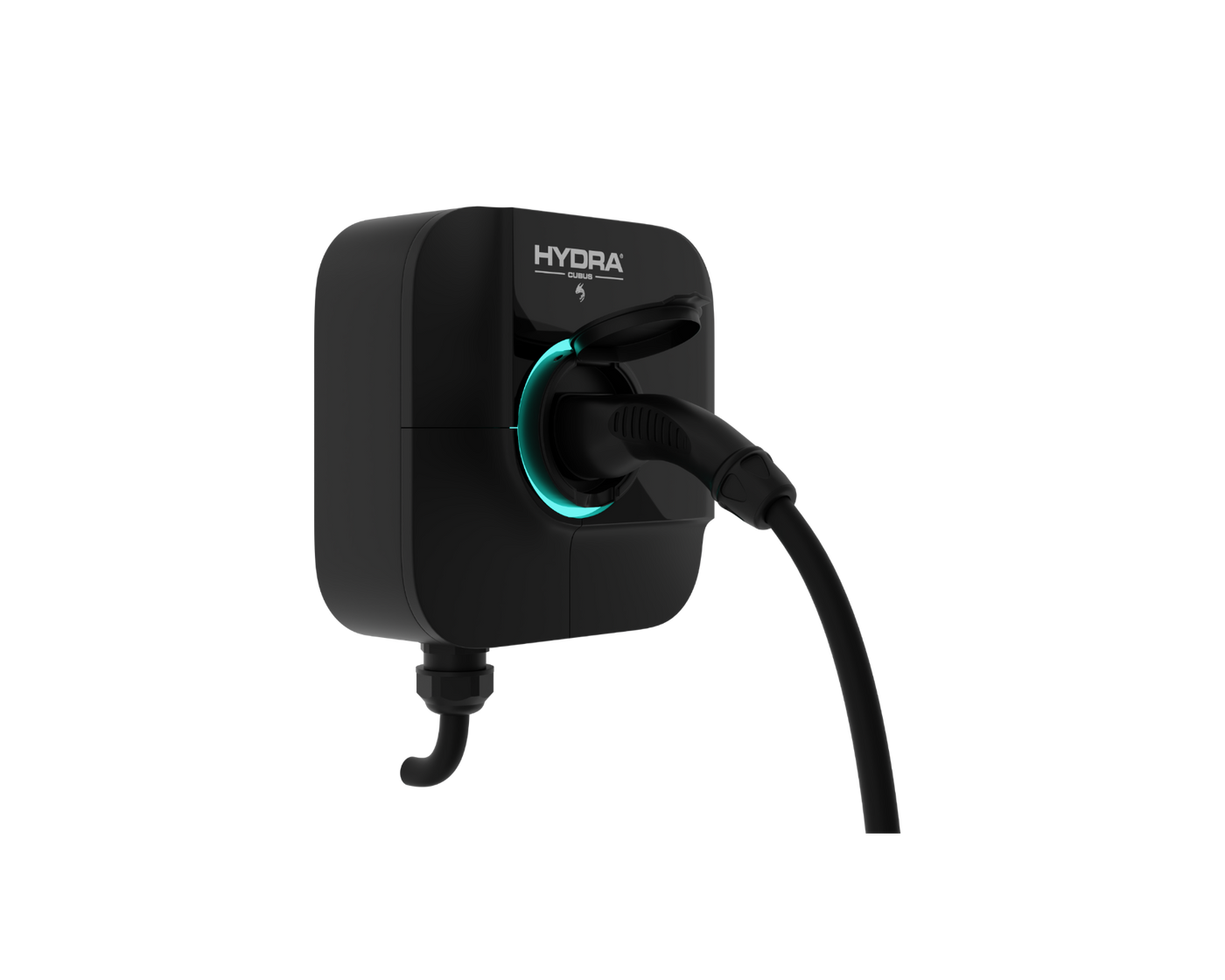
The Cubus is square: 260 x 260 x 100mm, mounting flush to the wall. The PC+ASA housing is UL94 V-0 fire rated and carries an IK10 impact rating, so it handles the knocks a wall-mounted charger picks up over time. At 3.5kg in socketed form (5.5kg tethered), one installer can manage it.
The socketed variant is IP54: dust-protected and splash-resistant from any direction. That covers a sheltered exterior wall or garage. The tethered version is IP65, sealed against water jets. Both run from -25°C to 50°C, so a cold British winter is not an issue. The finish is white. It sits on brick or rendered walls without drawing attention to itself.
Installation
Installing most smart chargers in the UK requires a separate Type B RCD. Standard AC RCDs do not detect DC fault currents; a Type B one does. Budget £80 to £150 for the part and the labour to fit it. The Cubus builds one in, so that line disappears from the quote.
The O-PEN protection removes the other common complication. PME earthing covers most UK homes, and OZEV guidelines require specific protections on it. Without built-in O-PEN protection, the installer often needs to drive an earth electrode into the ground. The Cubus handles this internally, so no groundworks are needed on compliant PME supplies.
You still need a certified OZEV-approved electrician. The unit takes a dedicated 40A MCB on its own circuit with a minimum 6mm² cable. Cable entry is bottom-mounted through a Ø18 to 24mm knockout. Most installations take 2 to 4 hours.
Charging Speed
At 7.4kW the Cubus delivers the fastest charge speed a standard UK single-phase supply can handle. A 75kWh battery, as found in the Volkswagen ID.4 or Kia EV6, charges from near-empty overnight in around 10 hours. A 40kWh battery, as in the Nissan Leaf or Mini Electric, takes around 6 hours.
Output is adjustable from 6A to 32A through the installer app. If the supply circuit shares headroom with other appliances, or you want charging to follow solar output through the day, the range gives the software room to work.
Solar Charging Modes
The Cubus supports two solar modes, controlled through the Hydra Nexus Pro app.
ECO mode draws a grid baseline and adds available solar on top. On a cloudy day when solar output falls short of the minimum charge current, the car still charges at a reduced rate.
ECO+ mode waits for enough solar generation to meet the 1.4kW start threshold, then tracks output as conditions change. The 6 to 32A adjustable range lets the charger follow generation levels without repeatedly stopping and restarting the session.
App and Smart Features
The Hydra Nexus Pro app covers scheduling, session history, charge limits, and remote start/stop. The built-in RFID reader adds access control without extra hardware, useful in households with more than one driver or on a small commercial site.
Most home chargers offer Wi-Fi, sometimes with Bluetooth for the initial setup. The Cubus also supports Ethernet and 4G as full, permanent connections. That matters in a garage at the far end of a property with poor wireless coverage, or in a commercial location where a wired connection is preferred.
OCPP 1.6 support lets the unit connect to third-party back-office systems, opening it to small fleet and workplace installations that need centralised reporting.
Supported smart tariffs: Octopus Intelligent Go, Octopus Go, Octopus Agile, OVO Charge Anytime, E.ON Drive, British Gas Electric Driver.
Key Benefits
- Built-in Type B RCD removes the need for a separate protection device on site
- O-PEN protection removes the need for an earth electrode on most UK PME supplies
- Four connectivity options: Wi-Fi, Bluetooth, Ethernet, 4G
- OCPP 1.6 support for small fleet and workplace use
- Solar diversion via ECO and ECO+ modes
- Built-in RFID reader for access control
- Load balancing across up to 32 units
- OZEV approved for up to £500 off installation
- 3-year manufacturer warranty
- Available tethered or socketed
Things to Consider
- The socketed variant is IP54; some competitors offer IP65 across both variants
- No V2G (vehicle-to-grid) support
- Hydra is a smaller brand with fewer independent reviews than Hypervolt or Ohme
- Confirm tethered cable length options with ON-EV before ordering
Hydra Cubus EV Charger | 7.4kW | Type B RCD | OZEV Approved | £354
Frequently Asked Questions
Is the Hydra Cubus OZEV approved?
Yes. It qualifies for the EV Chargepoint Grant, covering up to £500 off a home installation by a certified OZEV-approved installer.
Does it need a separate Type B RCD?
No. A Type B RCD is built in, detecting both DC and AC fault currents. You do not need a separate downstream protection device, which reduces what the electrician needs to source and fit.
What is O-PEN protection and why does it matter?
PME earthing is the arrangement used in most UK homes. Without O-PEN protection, OZEV guidelines require an earth electrode to be driven into the ground, which adds groundwork, time, and cost to the job. The Cubus handles this protection internally on compliant PME supplies, so no electrode is needed.
Does it integrate with Octopus Intelligent?
Yes, along with Octopus Go, Octopus Agile, OVO Charge Anytime, E.ON Drive, and British Gas Electric Driver.
Can it charge using solar power?
ECO mode blends grid and solar to keep charging when cloud cover limits generation. ECO+ mode waits for enough solar output before starting a session, then adjusts as generation changes through the day.
What is the IP rating?
IP54 on the socketed variant and IP65 on the tethered variant. Both carry an IK10 impact rating.