
Solar EV Charger: Which Homes Get the Most From Solar Diversion
The Short Answer
A solar EV charger pays off most in homes where the car is plugged in during daylight: home workers, retired households, shift workers and families with a second car that stays on the drive. Commuters gain less from diversion alone and should pair it with an off-peak tariff. The Zappi V2.1, Hypervolt Home 3 Pro and Indra Smart PRO all divert surplus solar.
Which homes get the most from solar diversion?
Homes with the car on the drive between late morning and mid afternoon get the most from solar diversion. That means home workers, retired households and anyone on shifts. Surplus generation peaks when the sun is highest, so the car has to be plugged in then to take it.
If you are in and out, the Zappi's Eco mode suits you. The Zappi V2 review describes Eco as adjusting the charge rate to your surplus while holding a minimum draw to keep the session moving during low generation. If the car sits on the drive all day and you are not in a rush, Eco+ fits, which the review describes as surplus solar only. The Zappi V2 review covers how each mode behaves in more detail.

Does a solar charger still work if you commute?
A commuter whose car leaves early and returns in the evening can still use a solar charger, but diversion will cover little of the charging. Most of the car's energy will come overnight from the grid, so scheduling and tariff support matter more than solar modes.
Weekends are where you gain. A car that stays home on a sunny Saturday can run on surplus in Eco or Eco+. For the rest of the week, you can schedule off-peak grid charging for nights when solar output is insufficient. Our guide to choosing a smart charger for a night tariff lists what to check on that side.
How much does panel size matter?
Panel size decides how often your surplus is big enough to run a charger at all. A small array often has little left once the house takes its share, so a surplus-only mode will pause often. A larger array leaves more spare power at midday, which suits surplus-only charging.
Look at your inverter app before choosing a mode. If you rarely see exported power on weekdays, plan on Fast or Eco for the days you need miles, and treat Eco+ as a bonus for sunny days when the car is home. The Zappi V2 review describes Eco+ as pausing the session when generation drops below the minimum, then carrying on when it recovers.
What changes if you have a home battery?
A home battery draws on the same surplus as the car, so the two compete for midday power. Which one takes priority depends on how the battery is set up, so check its settings before judging how well a charger diverts. We have no battery pairing details for these three chargers, so confirm with the battery maker before relying on a combination.
If you do have a battery, the car's need matters. A car that must be full by the morning suits Fast on the Zappi, which the Zappi V2 review describes as using grid and solar together.
Which charging mode suits which home?
Fast mode suits a home that needs the car full whatever the weather. Eco suits a home that wants solar first with a steady minimum. Eco+ suits a home with a flexible car and enough midday surplus. Those are the Zappi's three modes, and the Hypervolt Home 3 Pro has three of its own.
- Home all day, large array: Eco+ on the Zappi, which our review describes as surplus solar only.
- Home some days, small array: Eco, which our review describes as keeping a minimum draw going during low generation.
- Car needed full by morning: Fast, which our review describes as charging at full speed, ignoring generation levels.
- Commuter with weekend gaps: an off-peak schedule on weekdays and a solar mode at weekends.
The Hypervolt Home 3 Pro names its modes Eco, Boost and Super Eco. We do not describe each one here, so read Hypervolt's own guide to see how they behave. The Indra Smart PRO charges automatically from excess solar generation, and we have no named modes to give you for it.
Which solar EV charger should you look at?
Three chargers on our site suit solar homes, and all three are 7.4kW single phase. The Indra Smart PRO starts lowest of these three at £414.00. The Zappi V2.1 gives you three named modes with a CT clamp included. The Hypervolt Home 3 Pro adds a longer cable choice. Browse them all in our solar compatible chargers.
| Charger | Solar features | Connector | Price from |
|---|---|---|---|
| Zappi V2.1 | Fast, Eco, Eco+ modes; CT clamp included | Untethered socket or tethered 6.5m | £654.90 |
| Hypervolt Home 3 Pro | Eco, Boost, Super Eco modes | Tethered, 5m, 7.5m or 10m | £624.00 |
| Indra Smart PRO | Solar surplus divert via CT clamp | Untethered socket or tethered 6m | £414.00 |
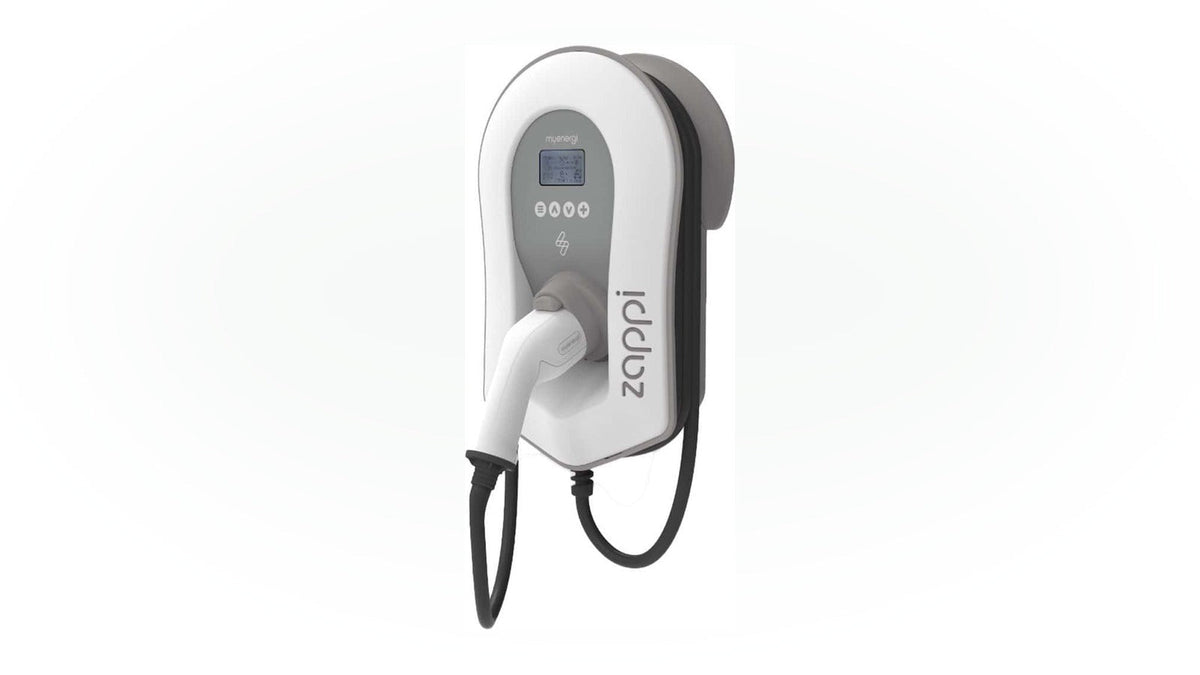
Myenergi Zappi V2.1 EV Charger
The Zappi V2.1 suits a home that wants to choose between full speed and surplus-only charging day by day. Prices start at £654.90 untethered, or £663.00 tethered. An electrician fits the CT clamp at your consumer unit.
The Hypervolt Home 3 Pro starts at £624.00 with the 5m cable. If your drive is long or the charger sits on the far side of the car, the 7.5m and 10m options help. Our tethered vs untethered guide helps with the connector choice.

Indra Smart PRO EV Charger
The Indra Smart PRO starts at £414.00 untethered in white. It suits a home that wants solar diversion without choosing between modes each day.
Hypervolt Home 3 Pro EV Charger
Frequently Asked Questions
Do I need solar panels to use a solar EV charger?
No. A solar charger also charges from the grid, and you can schedule it for off-peak times. The solar modes only help once you have panels and a CT clamp to measure your surplus.
What does the CT clamp do on a solar EV charger?
The CT clamp measures the electricity flowing at your consumer unit, so the charger can tell how much surplus solar you have. The Zappi V2.1 includes one, and the Indra Smart PRO diverts surplus via a CT clamp.
Can I use a solar EV charger with a cheap night tariff?
Yes, with the right model. The Zappi V2.1 works with Octopus Intelligent Go, Octopus Go and Octopus Agile, among others. Check the tariff name against the charger page before you buy.