
The Easee Range Explained: One vs Charge vs Charge Max (UK 2026)
Last updated: 3 September 2026
The Short Answer
Easee's UK range covers three chargers. The Easee One is the single-phase 7.4kW model built for standard UK homes, from £480. The Easee Charge steps up to 22kW three-phase output for properties with a three-phase supply, from £706.20, and comes in five colours. The Easee Charge Max adds a certified MID meter for accurate, billable energy readings, from £870. For most UK driveways on a standard single-phase supply, the Easee One is the right starting point. For a three-phase property, the choice between Charge and Charge Max comes down to whether you need to bill someone for the electricity.
Easee Range Comparison
| Model | Power | Supply | Weight | Warranty | Price from |
|---|---|---|---|---|---|
| Easee One | 7.4kW | Single-phase | 1.5kg | 3 years | £480 |
| Easee Charge | 22kW | Three-phase | 1.3kg | 3 years | £706.20 |
| Easee Charge Max | 22kW | Three-phase | 1.6kg | 5 years | £870 |
Easee One EV Charger | 7.4kW | Tethered or Untethered
Easee One: Built for UK Homes
The Easee One is Easee's single-phase 7.4kW charger, designed around the UK domestic supply most homes actually have. At 1.5kg it's one of the lightest smart chargers on the market, and it switches between tethered and untethered from the same unit rather than forcing you to choose a fixed configuration at purchase. It also runs up to three charging points from a single fuse via Easee's Power Sharing, which cuts electrical infrastructure cost for a two-car household. RFID access control ships built in, and a lifetime 4G eSIM means it runs independently of your home broadband. Full detail is in ON-EV's standalone Easee One review.
Easee Charge and Charge Max: Easee's Three-Phase UK Range
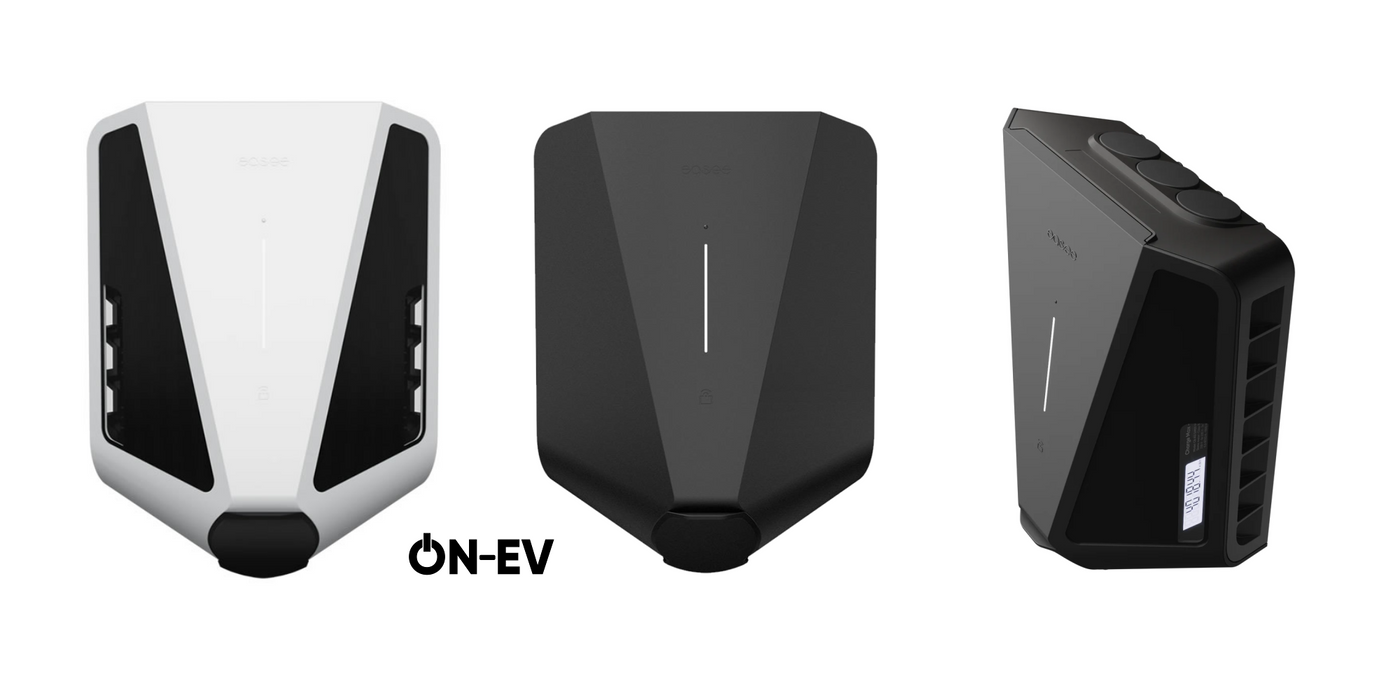
Both units deliver 22kW through a three-phase Type 2 socket, roughly three times the output of the Easee One, and both are built and rated for UK installations rather than being EU imports. The Easee Charge is the successor to Easee's discontinued Charge Lite, keeping the same 1.3kg compact footprint with improved internals underneath. It ships in five colourways, Black, Red, White, Grey and Blue, so it doesn't have to be the usual black or white box on the wall. A cable lock feature turns the socket into a fixed-tethered point if you'd rather not carry a separate cable.
The Easee Charge Max carries the same 22kW output but adds a built-in MID Class B meter, accurate to within ±1%, against the ±2% typical of standard Class C meters most competitors use. It also adds Bluetooth to the Charge's WiFi and 4G connectivity, giving it three ways to stay online, useful on a commercial site or car park where WiFi signal doesn't reach the charger reliably. The trade-off for the extra accuracy and connectivity is £163.80 more than the standard Charge, and a heavier 1.6kg polycarbonate body.
Both models run OCPP 1.6J with no SIM lock, so either connects to whichever back-office platform or tariff you choose rather than locking you into Easee's own billing. RFID cards and Plug & Charge cover authentication on both, and Power Sharing links up to three units on one electrical connection, the same multi-charger approach used on the Easee One.
Easee Charge 22kW | Type 2 Socket
Easee Charge Max 22kW | Type 2 Socket | MID
Billing Accuracy: Why the MID Meter Class Matters
A standard Class C MID meter, the type built into most metered chargers, is accurate to within ±2%. The Charge Max's Class B meter halves that margin to ±1%. On a single household charging one car, the difference is negligible. Across a landlord's rental property, a small business reclaiming electricity costs, or a fleet running dozens of sessions a month, that extra accuracy stops rounding errors from accumulating into a real discrepancy over a billing period. If you don't need to bill anyone for the electricity, the standard Easee Charge does the same charging job without paying for metering precision you won't use.
Do You Actually Need Three-Phase?
Three-phase electricity supply is uncommon in UK homes. Most residential properties run single-phase, which caps charging speed at 7.4kW regardless of the charger's rated output. A 22kW charger only delivers 22kW if the property has a three-phase connection to match. Check your supply before choosing between the One and the Charge range: if you're on single-phase, the One's 7.4kW is the ceiling either way, and it costs less.
Load Balancing and Solar: The Easee Equalizer
None of the three chargers include dynamic load balancing or solar diversion as standard. Easee sells the Easee Equalizer separately, a DIN-rail mounted device that monitors total household or site current and manages it across your chargers. Added to the Charge or Charge Max, the Equalizer also unlocks phase balancing, automatically switching a charging session between single-phase and three-phase draw depending on what the supply has available at that moment, plus power sharing across up to three Charge Max units on one connection. If solar self-consumption or dynamic load management matters to your install, budget for the Equalizer alongside whichever Easee charger you choose.
What's Common Across the Range
All three chargers run Easee's own app for scheduling, session control and energy history, and RFID plus Plug & Charge cover authentication across the board. Power Sharing lets up to three units run from a single electrical connection on any model in the range. OCPP 1.6J support with no SIM lock means every charger can also work with third-party smart charging or fleet management platforms rather than locking you into Easee's app and billing specifically, useful if your business already runs its own energy management system.
Warranty: One Real Gap in the Range
The Easee One and Easee Charge both carry a three-year warranty. The Charge Max steps up to five years, in line with its higher price and its positioning toward commercial and billable installs where a longer warranty term matters more. If warranty length is a deciding factor and you're comparing the standard Charge against the Charge Max, that's the other real difference beyond the meter.
Browse the full ON-EV home EV charger range
Frequently Asked Questions
Which Easee charger should I buy for a UK home?
The Easee One, unless you have a confirmed three-phase electricity supply. Most UK homes are single-phase, which caps charging at 7.4kW regardless of a higher-rated charger.
What's the difference between Easee Charge and Charge Max?
Charge Max adds a Class B MID meter accurate to ±1%, versus no meter on the standard Charge, plus Bluetooth connectivity and a longer five-year warranty. Both deliver the same 22kW three-phase output.
Does the Easee Charge come in different colours?
Yes. It's available in Black, Red, White, Grey and Blue.
Can the Easee One reach 22kW?
No. It's a single-phase 7.4kW charger by design. For 22kW you need a three-phase supply and either the Charge or Charge Max.
Do I need the Easee Equalizer?
Only if you want dynamic load balancing, solar self-consumption, or phase balancing on the Charge range. None of the three chargers include this as standard, it's a separate accessory.
Do all Easee chargers work with the same app?
Yes, all three run on Easee's app, and all support OCPP 1.6J with no SIM lock for compatibility with third-party smart charging platforms.